Quantum Phenomena: How Does Quantum Mechanics Really Work?
By Julia Czapran
Before the 20th century, physics was dominated by classical mechanics - Newton’s laws and Maxwell’s electromagnetism - the physics that most people studied at one point in their lives. Scientists believed the universe was like a perfectly predictable machine: if you knew all positions and velocities, you could calculate everything else. But what if that physics is outdated? What if there is something else underlying everything we know so far? That’s where Quantum Mechanics enters the picture. It’s easy to believe it now, 125 years after it was discovered, being surrounded by quantum technologies, but it wasn’t so obvious back then - not all scientists were convinced by this groundbreaking theory at the time. Absolutely justifiable attitude - great scientists need real proof before they believe in a theory.
The deterministic view on the world began to crack when certain experiments couldn’t be explained by classical theories - especially those involving light and heat. In 1900, Max Planck was studying how hot objects emit radiation - the so-called “blackbody radiation problem.” Classical physics predicted something absurd: at high frequencies, energy emission should become infinite (“ultraviolet catastrophe”). To fix this, Planck made a desperate mathematical trick: he assumed energy could only be emitted in discrete packets, or “quanta”. This was the first spark of quantum thinking that initiated the chain of discoveries that led to the quantum world we live in now.
Following Planck’s brave idea, Albert Einstein proposed that light itself is made of quanta - later called photons. He explained the photoelectric effect (why light can knock electrons out of metal) with this phenomenon which led to winning a Nobel Prize in 1921. This later showed the wave-particle duality of light - the fact that light behaves both like a wave and a particle at once - a fundamental concept in physics. Throughout the next 100 years, brilliant scientists like Bohr, Heisenberg, Schrödinger, and Born added next steps to the quantum idea, expanding it with concepts that put some fresh light on basic physical concepts. A key takeaway from all their work is that the universe is not deterministic - certainty gave way to probability, implying the word we live in to be fully probabilistic. The famous “Uncertainty Principle”, formulated by previously mentioned physicist Heisenberg, says: “You can’t know both the position and momentum of a particle exactly at the same time”. This lies exactly at the very core of Quantum Mechanics - nothing is fully determined, all we can know are probabilities of particles being in a certain place at a certain time. This isn’t due to bad instruments - it was a limit built in the nature of our world.
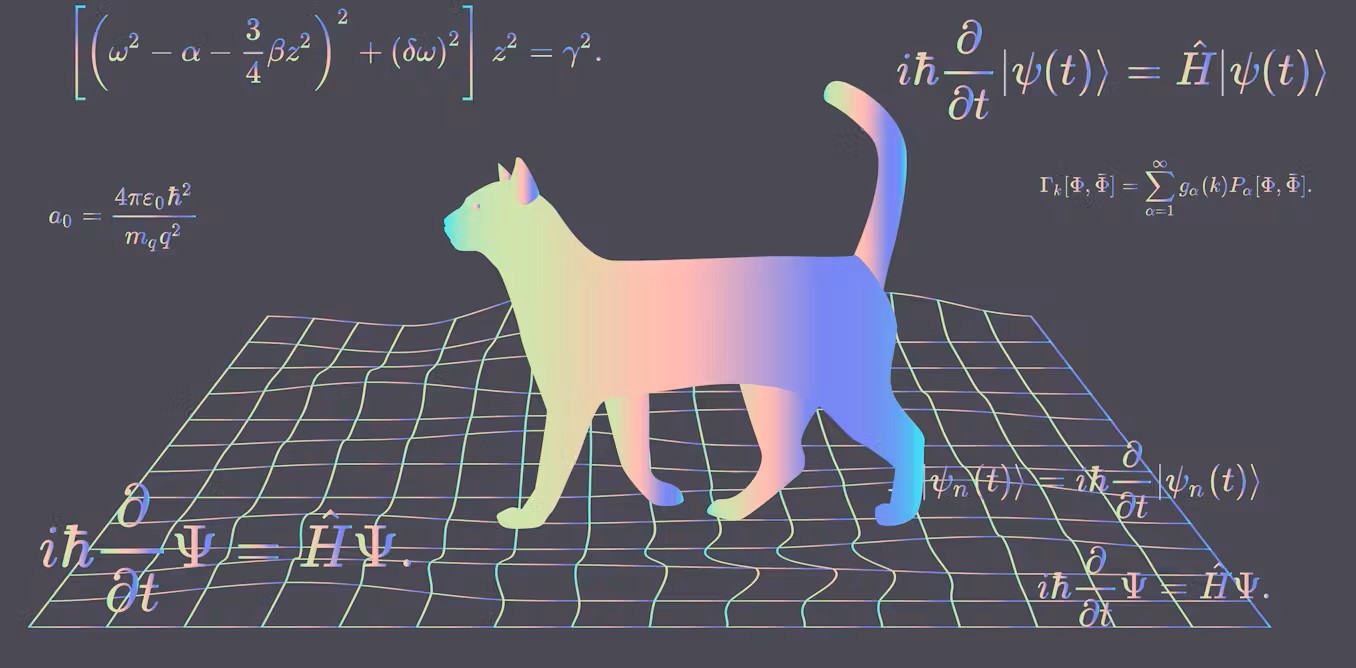
What came next caused a huge split between the scientists, leading to infinite debates and legendary discussions. A controversial statement, called the Copenhagen Interpretation, was formulated by Bohr with a group of other physicists, stating that the act of measurement collapses a system’s possible states into an outcome. Hence, reality, at the quantum level, doesn’t have definite properties until observed. That is exactly what the famous “Schrödinger’s cat thought experiment” is about. A hypothetical cat is put in a sealed box and is linked to a random quantum event. In that way, until the box is opened, the cat exists in both states simultaneously - being both dead and alive at the same time. After the box is opened, assuming the cat is alive, it will only remember being alive, as if the superposition never happened. The experiment was supposed to show how paradoxical and absurd Bohr’s theory is. Schrödinger was on the same side of the argument as Einstein, who never accepted the idea of indeterminism - he argued that quantum theory was incomplete, that there must be some hidden variables determining the outcomes. In 1935, together with Podolsky, and Rosen, he published the EPR paradox, using the idea of entangled particles to argue that quantum mechanics couldn’t be the full story. They believed such instant connections between distant particles - what Einstein called “spooky action at a distance” - were impossible, and that hidden variables must exist to explain them.
It was the next generation of scientists, not impacted by the old thinking way of Einstein’s generation, that made a huge step forward by unifying Quantum Mechanics with Special Relativity, creating Quantum Field Theory (QFT). This framework not only explained how particles interact but also became the basis of the Standard Model - the most successful physical theory ever built. The whole “quantum idea of the world” started to look more and more promising, however, the testing part that would confirm the ideas was still missing. That’s when an Irish physicist working at CERN, John Stewart Bell, devised in 1964 what later became known as Bell’s Theorem. He mathematically proved that no local hidden variable theory could reproduce all the predictions of quantum mechanics, contradicting Einstein’s belief. He derived an inequality - the Bell’s Inequality - which provided a concrete, testable way to distinguish between “Einstein’s world” (local realism) and “Bohr’s world” (quantum indeterminacy).
Soon after experiments began in order to test this inequality in real life. The most famous one was performed by Alain Aspect and his team in France at the beginning of the 80s. They created pairs of entangled photons and measured their properties at separate locations. By rapidly changing the measurement settings while the photons were in flight, they showed that the results were still correlated - too strongly to be explained by any hidden signals or classical causes. The outcome confirmed what quantum mechanics predicted: entangled particles remain linked no matter how far apart they are, proving that this very ‘spooky action’ Einstein doubted was real. This means that the universe really does behave nonlocally - what happens to one particle can instantly affect another, even across vast distances.
In the late 20th century, scientists began to realize that quantum mechanics isn’t just a theory of nature - it’s also a theory of information. This shift in thinking marked a turning point - instead of treating quantum mechanics as only describing particles, scientists began to see it as describing how information itself behaves in the quantum world. For example, a quantum bit, or qubit, can exist in multiple states at once - unlike a classical bit that can only be 0 or 1.This insight gave birth to quantum information science, which explores how superposition and entanglement can be used to process and transmit information in ways impossible for classical systems. This later led to discoveries of technologies like Quantum Computing or Quantum Cryptography - fields growing rapidly nowadays.
Despite the rapid growth of understanding quantum characteristics of particles, there are still dilemmas and problems to be solved. One of which being the search for the “theory of everything” that would unify Quantum Mechanics and General Relativity. Quantum mechanics governs the micro world of particles, while general relativity explains the cosmic scale of gravity - yet they don’t agree when both are needed (like inside black holes or at the Big Bang). There are some candidates for the unifying theory - like String Theory or M-Theory - neither of which is complete. Scientists continue to search for a single equation that can describe every particle, every force, and every moment in time - the ultimate blueprint of reality. The introduction of quantum theory seemed to bring more chaos than clarity in the bigger picture - but at least we have a bigger view now, even if some parts are still missing. That sense of incompleteness isn’t a flaw - it’s what makes the quantum world so endlessly fascinating.
Even after more than a century, quantum mechanics remains mysterious. Some parts of the theory are well known and proven, some are still waiting for a bright mind to be solved or even discovered. We’re assembling an enormous jigsaw, even though some of the pieces are still missing. Step by step, scientists are uncovering weird phenomena, letting each new generation look at them from a different perspective. We must try to find the missing puzzles and slowly put them all together, but as Richard Feynman famously said: “If you think you understand quantum mechanics, you don’t understand quantum mechanics”. As pessimistic as it may sound, I believe there is hope in that sentence. That not-yet-fully-understood theory can inspire new generations, hopefully leading to discoveries and innovations that will shape the future of science.